In the context of hand-held tools, chucks and collets are both used to hold cutting tools, drill bits, or workpieces in place. Despite serving a similar purpose, they have distinct designs, mechanisms, and applications. Understanding the differences between a chuck and a collet is crucial for selecting the appropriate device for a given task. Below is a detailed comparison.
Chuck
Definition: A chuck is a clamping device that can hold various tools or workpieces, typically used on lathes, drills, and milling machines. You may be familiar with a drill chuck used in most common drills.
New to collets? Start with What Is a Collet? for the basics, then come back here for the comparison.
Types of Chucks:
Three-Jaw Chuck (Universal Chuck):
- Most common type.
- Self-centering with three jaws that move simultaneously.
- Ideal for holding round or hexagonal workpieces.
- Opens and closes using a Chuck Key
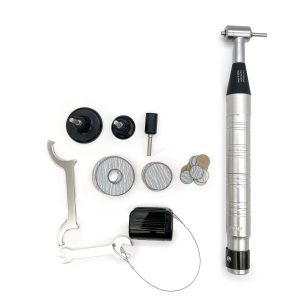
- The most versatile flexible shaft handpiece Foredom’s H.30 opens from 0” to 5/32” (4mm).
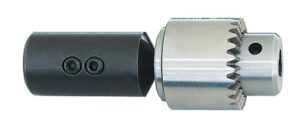
- Three-Jaw Chuck also comes as a lathe attachment
Drill Chuck:
- Typically used in drills.
- Can be key-operated (tightened with a key) or keyless (hand-tightened).
- Holds drill bits or other cylindrical tools.
Advantages:
- Can hold a wide variety of tool sizes and shapes.
- Quick and simple to change tools or workpieces.
- Suitable for heavy-duty applications.
Disadvantages:
- Generally, less precise than collets, with potential for slight misalignment.
- Typically, larger and heavier than collets, which might not be ideal for all setups.
Collet
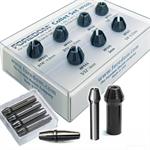
Definition: A collet is a subtype of chuck that forms a collar around an object to be held and exerts a clamping force when it is tightened. Collets are typically used in milling machines, lathes, routers, flexible shaft handpieces and micro motor handpieces and other precision machinery.
Advantages:
- High accuracy and minimal runout, making them ideal for precision machining.
- Provides excellent gripping force due to uniform pressure around the tool or workpiece.
- Smaller and lighter than chucks, beneficial for space-constrained setups.
- Only a very few models of flexible shaft handpieces do not require a tool to change bits. They use a lever or paddle mechanism. These are under constant tension and should always have a bur or test shank loaded even when not in use.
Disadvantages:
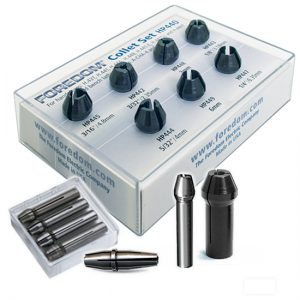
- Each collet size is specific to a narrow range of diameters, necessitating multiple collets for different sizes. Also, collets are usually specific to the model handpiece and manufacturer and are not interchangeable between different brands.
- Changing collets can be more time-consuming compared to chucks, particularly if frequent size changes are required.
Choosing between a chuck and a collet depends on the specific requirements of your task. If precision and minimal runout are crucial, a collet is the better choice. For general-purpose use, versatility, and ease of changing tools, a chuck is often more suitable. Understanding these differences ensures that you select the right tool-holding mechanism to optimize performance and accuracy in your work.
Here at Foredom our H.30 uses a Three-Jaw Chuck.
Foredom has a chuck available compatible with the Foreodm Bench Lathe
Our sister company Handler offers a 18 Atlas Precision Chuck with their Lathe
We also have lots of collet options.