Search

Is My Shaft Broken?

Is My Shaft Broken?

Why Isn't My Bur Spinning but my Motor is Running?

Many customers encounter a situation where their Flexible Shaft's motor seems to be running, but the bur isn't spinning. In this article we will discuss reasons, troubleshooting and offer preventative measures.

Common Reasons for the Issue

  • A Broken inner shaft can occur due to the bit being stopped short because it got caught in your shirt, shop apron or on a knot in the wood while the motor is still running under power.
  • Or has the set screw that holds the inner shaft coupling came loose from the motor shaft. This would let the motor spin but not the flexible shaft. It might also let the loose set screw fall into the bottom of the motor connector and let it chew up the shaft and sheath.
  • Was the shaft bent or kinked and then used? Do not bend the shafting more than a 4” radius (like bending it over a basketball.)

Troubleshooting Guide

Visual Inspection

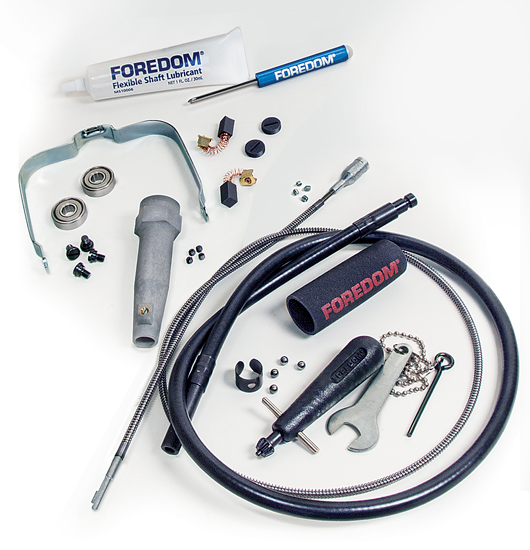
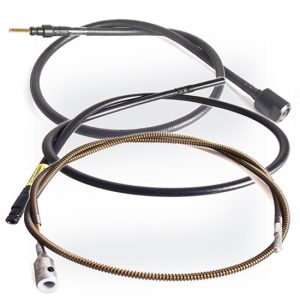
You should visually inspect the shaft and sheath for any obvious signs of wear, kinks, or foreign objects. Next, you should take it apart to check each component. The motor must be unplugged from the power source first. Then, remove the handpiece from the shafting. Next, using a 1” crescent wrench or adjustable wrench, remove the motor connector from the motor hub. The motor connector is the gray plastic conical piece below the motor. It has a LEFT-HAND thread, which is opposite to the way you normally would loosen or tighten a piece of hardware. Once it is loose, you can then see the inner shaft coupling. Is it securely tightened and in place? If it is, then you can loosen the set screw that holds the inner shaft coupling to the motor shaft. Now you can remove the inner shaft from the outer sheath and motor connector. You can loosen the set screw that holds the sheath to the motor connector now. A word of warning, it can get messy here since the shaft has a coating of grease. You might want to do this on a sheet or two of old newspaper. Now check it for any breaks or kinks on the shaft. If the break is located somewhere in the sheath, you should probably replace the sheath since many times broken pieces imbed inside the inner sheath wall and can damage the new shaft.

Once you replace the shaft you need to lubricate it with a very minimal amount of high temperature lithium grease down the shaft to about the last 6 inches. Next, replace the motor connector and tighten it snug (not super tight) onto the motor. Then, slide the sheath on, plain end first. You should have ¾” of the shaft key tip sticking out of the sheath end with the groove as it hangs vertically. You can do this by sliding the plain end of the sheath in or out of the motor connector before you tighten the set screw there. Before you attach the handpiece, you should run in the grease and silencer spring, which is attached to the shaft. The silencer spring helps prolong the life of the shaft and sheath by letting the rotating shaft run inside the silencer spring. You can run them in by turning it on and hanging the shaft in an unlined waste can. Run it for 15 to 20 minutes at high speed. This will redistribute the grease and warm it up. It will also help “set” the silencer spring on the inner wall of the sheath and not spin with the shaft causing a harmonic vibration. Then, wipe off the excess grease that comes out of the sheath before attaching the handpiece.

Preventive Measures

  • Regular maintenance can help to prevent such issues from arising, such as lubricating the shaft every 40 to 50 hours of use and performing a cleaning in an alcohol bath once every 200 hours of use.
  • Do not bend the shafting more than a 4” radius (like bending it over a basketball.)
  • Be careful not to get the bur caught in clothing or other obstructions.
  • Wipe off any excess grease on the shaft tip after use.
  • Always hang up the handpiece or remove it when done from the shafting to prevent grease from migrating into it which makes it run hot.

View Flex Shaft Maintenance 

Conclusion

  • If your motor is running but the bur in the handpiece is not turning you probably have a broken or disconnected shaft.
  • Periodic maintenance such as lubricating the shaft helps prevent problems and reminds you to do a visual inspection and check the set screw connection.
  • You can find helpful information on our owner’s manuals, or videos on our website.

View Flex Shaft Tools 

You might also enjoy

What Is a Collet?

A collet is a sleeve that grips a rotating tool shank and holds it centered. See how collets work, what sizes Foredom handpieces take, and how to choose.
Read More